
tagged by: documentation
The Almighty Thud
Why you shouldn't write a lot of documentation.
Podcast on Agility and Architecture
Ryan Lockard (Agile Uprising) invited me to join Rebecca Wirfs-Brock for a podcast conversation on architecture on agile projects. Rebecca developed Responsibility-Driven Design, which was a big influence for me when I started my career. We talked about how we define architecture, the impact of tests on architecture, the role of domain models, what kind of documentation to prepare, and how much architecture needs to be done up-front.
Data Contracts
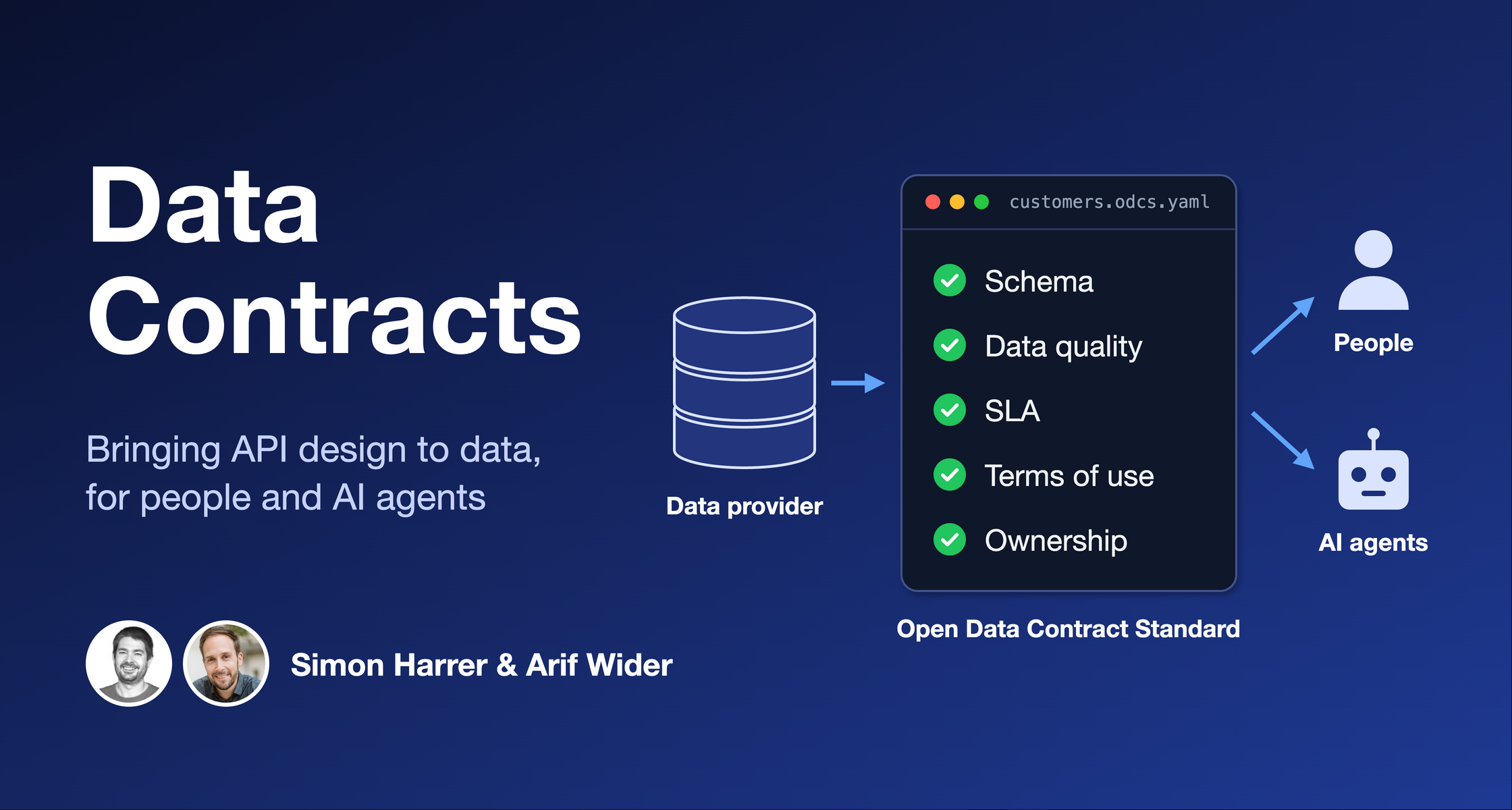
Data contracts are a way to describe the contents and guarantees of datasets. They apply practices from API design to data by treating them as data-providing services - such as data products - whose interfaces we want to define as clearly as possible. This approach significantly increases the robustness of large-scale data landscapes, and gives both people and AI agents the explicit, trustworthy metadata they need to work with data autonomously, which is why more and more enterprises are adopting them.
Code As Documentation
One of the common elements of agile methods is that they raise programming to a central role in software development - one much greater than the software engineering community usually does. Part of this is classifying the code as a major, if not the primary documentation of a software system.
Generated Glossary
When we use LLMs in a specialized domain, such as the operations of any reasonably-large organization, there is a lot of specialized vocabulary. Such words and specialized meanings will be foreign to an LLM because they aren't in its training set, making it harder for the LLM to be effective when doing tasks in that domain. One technique to aid this is to use an LLM to generate a glossary of the terminology in that domain, and make this glossary available for any LLMs doing work in those circumstances.