
tagged by: object collaboration design
Inversion of Control Containers and the Dependency Injection pattern
In the Java community there's been a rush of lightweight containers that help to assemble components from different projects into a cohesive application. Underlying these containers is a common pattern to how they perform the wiring, a concept they refer under the very generic name of “Inversion of Control”. In this article I dig into how this pattern works, under the more specific name of “Dependency Injection”, and contrast it with the Service Locator alternative. The choice between them is less important than the principle of separating configuration from use.
Collection Pipeline
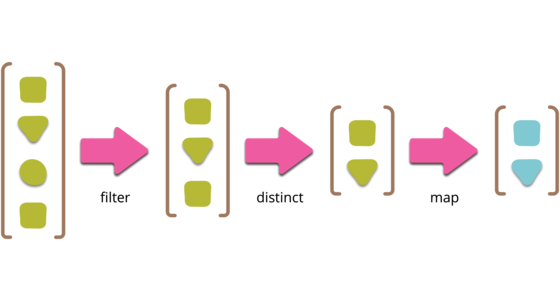
Collection pipelines are a programming pattern where you organize some computation as a sequence of operations which compose by taking a collection as output of one operation and feeding it into the next. (Common operations are filter, map, and reduce.) This pattern is common in functional programming, and also in object-oriented languages which have lambdas. This article describes the pattern with several examples of how to form pipelines, both to introduce the pattern to those unfamiliar with it, and to help people understand the core concepts so they can more easily take ideas from one language to another.
Dependency Composition
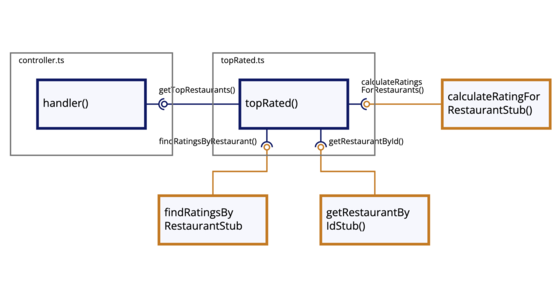
Based on frustrations with conventional framework-based dependency injection, I have adopted a composition strategy that utilizes partial application to inject context into modules. When combined with test-driven development as the design process and a focus on functions over classes, modules can be kept clear, clean, and mostly free of unintended coupling.
Refactoring: This class is too large
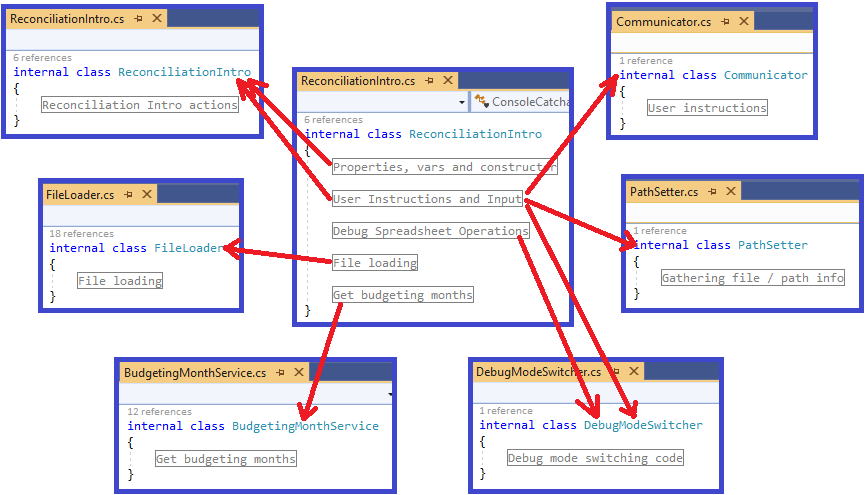
In this article I walk through a set of refactorings from a real code base. This is not intended to demonstrate perfection, but it does represent reality.
Refactoring code that accesses external services
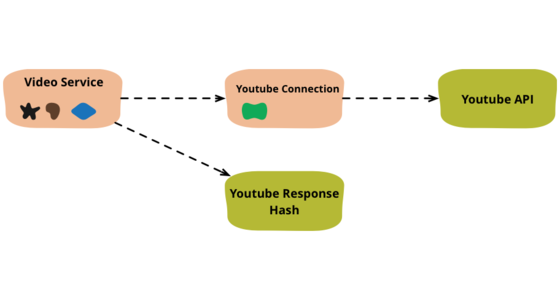
When I write code that deals with external services, I find it valuable to separate that access code into separate objects. Here I show how I would refactor some congealed code into a common pattern of this separation.
Refactoring with Loops and Collection Pipelines
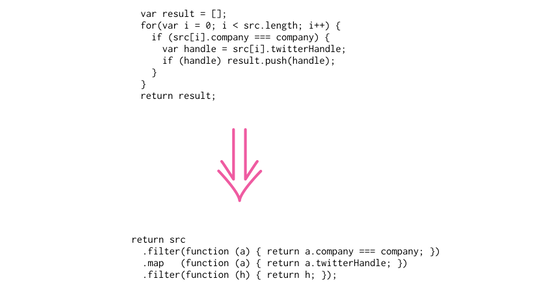
The loop is the classic way of processing collections, but with the greater adoption of first-class functions in programming languages the collection pipeline is an appealing alternative. In this article I look at refactoring loops to collection pipelines with a series of small examples.
DIP in the Wild

The Dependency Inversion Principle (DIP) has been around since the early '90s, even so it seems easy to forget in the middle of solving a problem. After a few definitions, I'll present a number of applications of the DIP I've personally used on real projects so you'll have some examples from which to form your own conclusions.
D D D_ Aggregate
Aggregate is a pattern in Domain-Driven Design. A DDD aggregate is a cluster of domain objects that can be treated as a single unit. An example may be an order and its line-items, these will be separate objects, but it's useful to treat the order (together with its line items) as a single aggregate.
Embedded Document
Flowing JSON data structures through a server is something I'm seeing more these days. JSON documents can be persisted directly, either by using an AggregateOrientedDatabase or a serialized LOB in a relational database. JSON documents can also be served directly to web browsers or used to transfer data to server-side page renderers. When JSON is being used in this way, I hear people saying that using an object-oriented language gets in the way because the JSON needs to be translated into objects only to be rendered out again - a waste of programming effort . I agree with the point about waste, but I argue that it's not a problem with objects but a failure to understand encapsulation.
Function As Object
In programming, the fundamental notion of an object is the bundling of data and behavior. This provides a common data context when writing a set of related functions. It also provides an interface to manipulating the data that allows the object to control access to that data, making it easy to support derived data and prevent invalid modifications of data. Many languages provide explicit syntax to define classes, which act as definitions for objects. But if you have a language with first-class functions and closures, you can use these constructs to create objects using the Function As Object pattern (originally described by Eugene Wallingford).
Gang Of Four
In my view the Gang of Four is the best book ever written on object-oriented design - possibly of any style of design. This book has been enormously influential on the software industry - just look at the Java and .NET libraries which are crawling with GOF patterns.
Getter Eradicator
You can tell them by the twitch in the left hand side of the mouth when they see a getter method, there's swift pull on their battleaxe and a satisfied cry as another getter is hewn unmercifully from a class which immediately swoons in an ecstasy of gratefulness at the manly Getter Eradicator's feet.
Hollywood Principle
A synonym for InversionOfControl.
Interface Implementation Pair
The practice of taking every class and pairing it with an interface. So as a result you see pairs of things - maybe ICustomer and Customer or Customer and CustomerImpl. In many ways it echoes the C/C++ habit of header files for each class, although in this case the interfaces and implementations are actually separate types.
Inversion Of Control
Inversion of Control is a common phenomenon that you come across when extending frameworks. Indeed it's often seen as a defining characteristic of a framework.
Lazy Initialization
Lazy Initialization is a technique that initializes a variable (in OO contexts usually a field of a class) on it's first access. It canonical form is something like this:
Required Interface
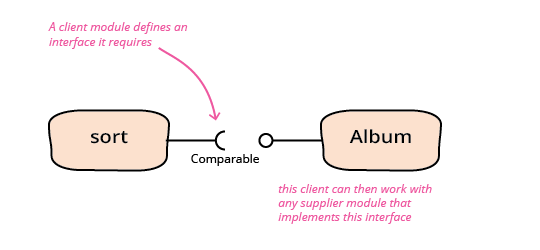
A required interface is an interface that is defined by the client of an interaction that specifies what a supplier component needs to do so that it can be used in that interaction.
Tell Dont Ask
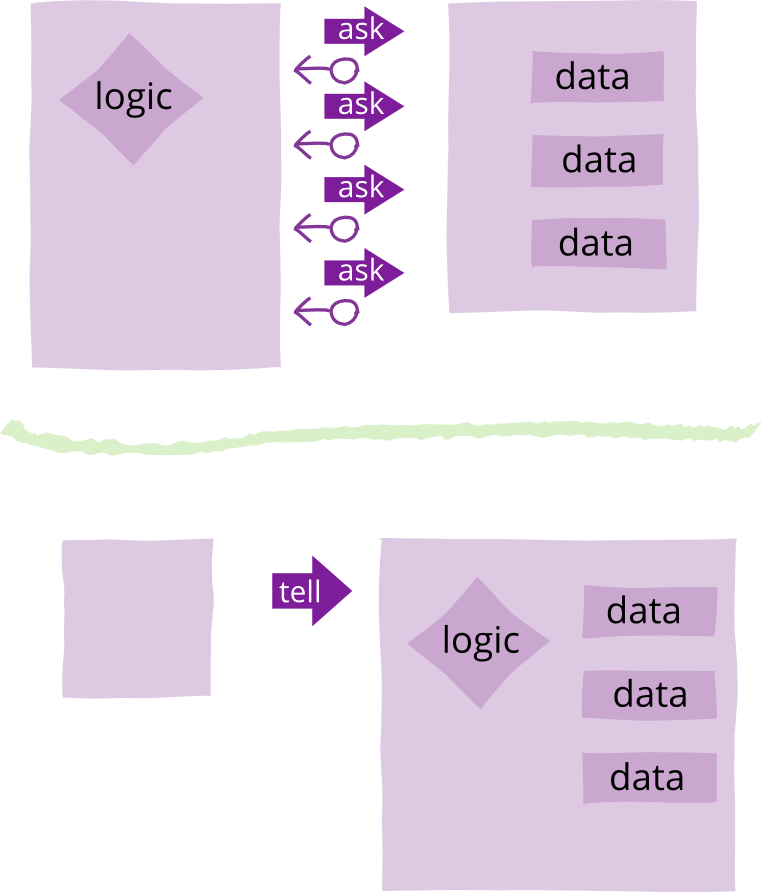
Tell-Don't-Ask is a principle that helps people remember that object-orientation is about bundling data with the functions that operate on that data. It reminds us that rather than asking an object for data and acting on that data, we should instead tell an object what to do. This encourages to move behavior into an object to go with the data.
Uniform Access Principle
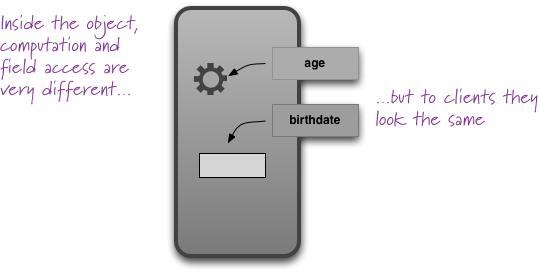
All services offered by a module should be available through a uniform notation, which does not betray whether they are implemented through storage or through computation.
-- Bertrand Meyer
Bertrand Meyer coined this principle in his highly-influential book Object-Oriented Software Construction.
The essential point of the principle is that if you have a person object and you ask it for its age, you should use the same notation whether the age is a stored field of the object or a computed value. It effectively means that a client of the person should neither know nor care whether the age is stored or computed.