
tagged by: encapsulation
Access Modifier
Object-oriented languages divide a program into modules called classes. Each class contains features, which consist of data (fields) and methods. (Not all languages use these terms, but they'll do for this.) Languages have various rules about what other classes can access the features of a class, these are often based on access modifiers that apply to a class.
Designed Inheritance
One of the longest running arguments on object-oriented circles is the debate between OpenInheritance and Designed Inheritance. The principle of Designed Inheritance is probably best summed up by Josh Bloch: "Design and document for inheritance or else prohibit it". With this approach you take care to decide which methods can be inherited and Seal the others to stop them being overridden.
Embedded Document
Flowing JSON data structures through a server is something I'm seeing more these days. JSON documents can be persisted directly, either by using an AggregateOrientedDatabase or a serialized LOB in a relational database. JSON documents can also be served directly to web browsers or used to transfer data to server-side page renderers. When JSON is being used in this way, I hear people saying that using an object-oriented language gets in the way because the JSON needs to be translated into objects only to be rendered out again - a waste of programming effort . I agree with the point about waste, but I argue that it's not a problem with objects but a failure to understand encapsulation.
Encapsulated Collection
If you learn about object-oriented design, you quickly learn that it's important to encapsulate your data. The simplest form of encapsulation is to use accessors (getting and setting methods) or properties - if your language supports it. (Some even do this within the class - SelfEncapsulation
Function As Object
In programming, the fundamental notion of an object is the bundling of data and behavior. This provides a common data context when writing a set of related functions. It also provides an interface to manipulating the data that allows the object to control access to that data, making it easy to support derived data and prevent invalid modifications of data. Many languages provide explicit syntax to define classes, which act as definitions for objects. But if you have a language with first-class functions and closures, you can use these constructs to create objects using the Function As Object pattern (originally described by Eugene Wallingford).
Getter Eradicator
You can tell them by the twitch in the left hand side of the mouth when they see a getter method, there's swift pull on their battleaxe and a satisfied cry as another getter is hewn unmercifully from a class which immediately swoons in an ecstasy of gratefulness at the manly Getter Eradicator's feet.
Observable State
What do people mean when they say a method doesn't change the observable state of an object?
Open Inheritance
This is the opposite attitude to DesignedInheritance. Advocates of open inheritance do not look to disallow inheritance by Sealing their classes or doing anything else to stop people inheriting classes.
Page Object
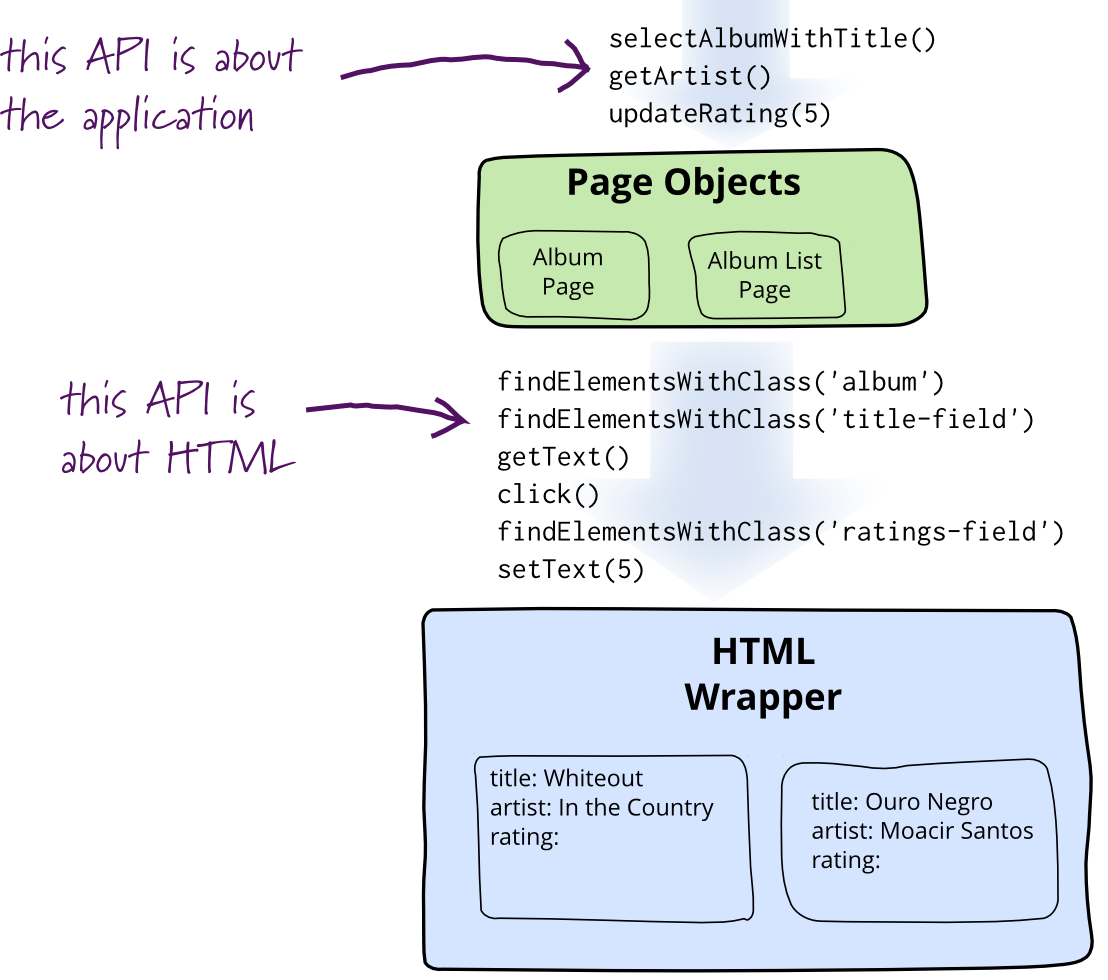
When you write tests against a web page, you need to refer to elements within that web page in order to click links and determine what's displayed. However, if you write tests that manipulate the HTML elements directly your tests will be brittle to changes in the UI. A page object wraps an HTML page, or fragment, with an application-specific API, allowing you to manipulate page elements without digging around in the HTML.
Presentation Domain Data Layering
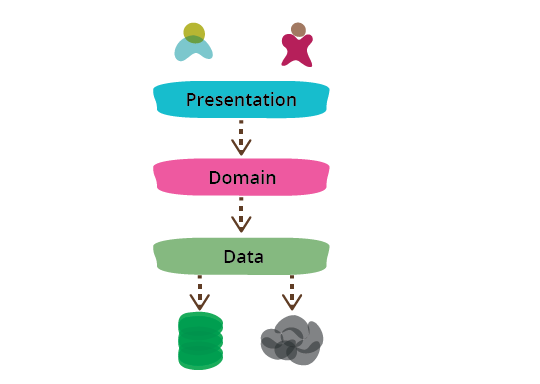
One of the most common ways to modularize an information-rich program is to separate it into three broad layers: presentation (UI), domain logic (aka business logic), and data access. So you often see web applications divided into a web layer that knows about handling HTTP requests and rendering HTML, a business logic layer that contains validations and calculations, and a data access layer that sorts out how to manage persistent data in a database or remote services.
Protected Data
Is it good OO design to have data in my classes with the protected AccessModifier?
Public Csharp Fields
When I first came across C# I liked the notion of properties
right from the start. The getX and setX conventions of C++/Java always
seems rather silly to me, it's much more natural to write obj.X
= other.X. Providing a property with get and set methods turns
a common convention into a naturally supported feature of the
language.
Published Interface
Published Interface is a term I used (first in Refactoring) to refer to a class interface that's used outside the code base that it's defined in. As such it means more than public in Java and indeed even more than a non-internal public in C#. In my column for IEEE Software I argued that the distinction between published and public is actually more important than that between public and private.
Seal
Sealing a method or a class prevents subclasses from overriding it.
Self Encapsulation
Data encapsulation is a central tenet in object-oriented style. This says that the fields of an object should not be exposed publicly, instead all access from outside the object should be via accessor methods (getters and setters). There are languages that allow publicly accessible fields, but we usually caution programmers not to do this. Self-encapsulation goes a step further, indicating that all internal access to a data field should also go through accessor methods as well. Only the accessor methods should touch the data value itself. If the data field isn't exposed to the outside, this will mean adding additional private accessors.
Software Component
The notion of changing software development from laboriously crafting code to building powerful systems by simple assembly of components has been a target since I entered our profession. It's target that is sometimes glimpsed, but never really attained - although many technologies have dangled the carrot of industrial reuse.
Tell Dont Ask
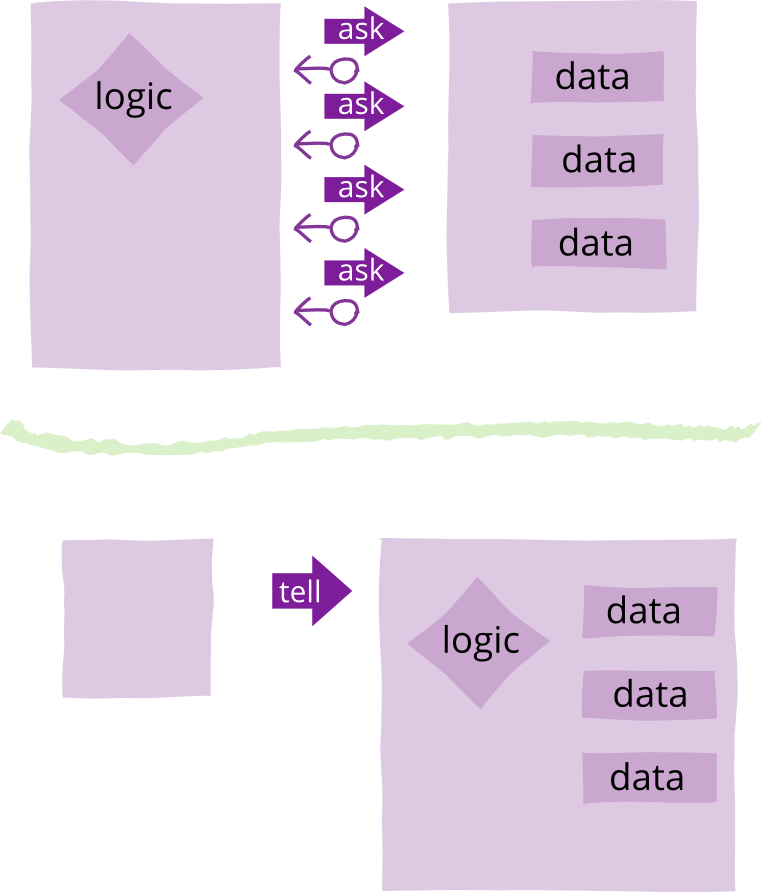
Tell-Don't-Ask is a principle that helps people remember that object-orientation is about bundling data with the functions that operate on that data. It reminds us that rather than asking an object for data and acting on that data, we should instead tell an object what to do. This encourages to move behavior into an object to go with the data.
Uniform Access Principle
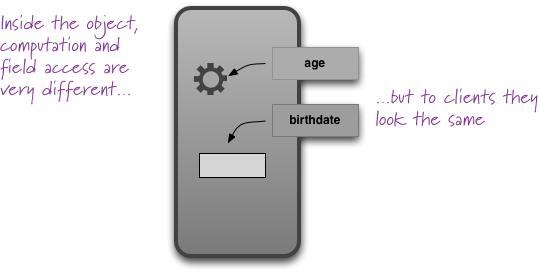
All services offered by a module should be available through a uniform notation, which does not betray whether they are implemented through storage or through computation.
-- Bertrand Meyer
Bertrand Meyer coined this principle in his highly-influential book Object-Oriented Software Construction.
The essential point of the principle is that if you have a person object and you ask it for its age, you should use the same notation whether the age is a stored field of the object or a computed value. It effectively means that a client of the person should neither know nor care whether the age is stored or computed.