
tagged by: evolutionary design
Is Design Dead?
For many that come briefly into contact with Extreme Programming, it seems that XP calls for the death of software design. Not just is much design activity ridiculed as "Big Up Front Design", but such design techniques as the UML, flexible frameworks, and even patterns are de-emphasized or downright ignored. In fact XP involves a lot of design, but does it in a different way than established software processes. XP has rejuvenated the notion of evolutionary design with practices that allow evolution to become a viable design strategy. It also provides new challenges and skills as designers need to learn how to do a simple design, how to use refactoring to keep a design clean, and how to use patterns in an evolutionary style.
Evolutionary Database Design
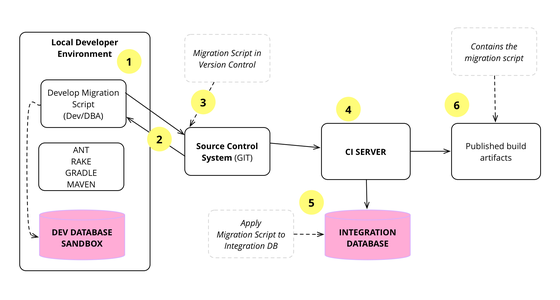
Over the last decade we've developed and refined a number of techniques that allow a database design to evolve as an application develops. This is a very important capability for agile methodologies. The techniques rely on applying continuous integration and automated refactoring to database development, together with a close collaboration between DBAs and application developers. The techniques work in both pre-production and released systems, in green field projects as well as legacy systems.
Patterns of Legacy Displacement
When faced with the need to replace existing software systems, organizations often fall into a cycle of half-completed technology replacements. Our experiences have taught us a series of patterns that allow us to break this cycle, relying on: a deliberate recognition of the desired outcomes of displacing the legacy software, breaking this displacement in parts, incrementally delivering these parts, and changing the culture of the organization to recognize that change is the unvarying reality.
Scaling the Practice of Architecture, Conversationally
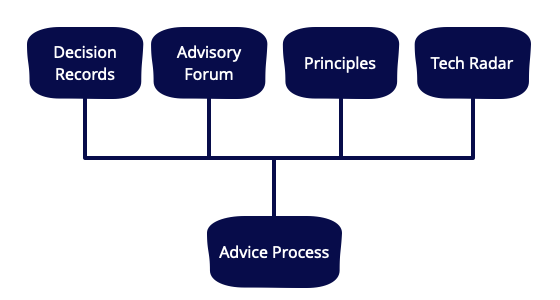
Architecture need not be a monologue; delivered top-down from the minds and mouths of a centralised few. This article describes another way to do architecture; as a series of conversations, driven by a decentralised and empowering decision-making technique, and supported by four learning and alignment mechanisms: Decision Records, Advisory Forum, Team-sourced Principles, and a Technology Radar
Schemaless Data Structures
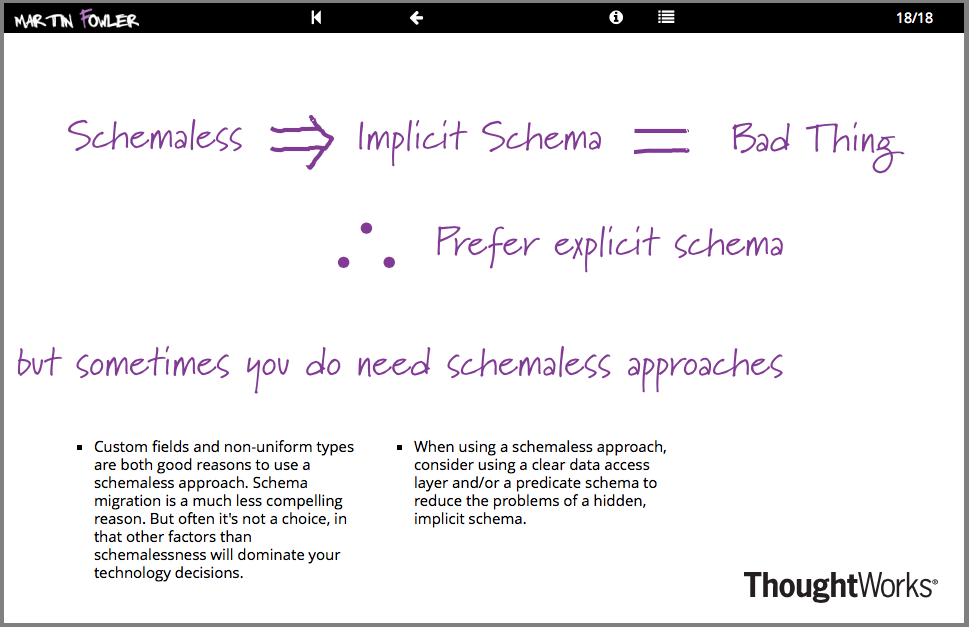
In recent years, there's been an increasing amount of talk about the advantages of schemaless data. Being schemaless is one of the main reasons for interest in NoSQL databases. But there are many subtleties involved in schemalessness, both with respect to databases and in-memory data structures. These subtleties are present both in the meaning of schemaless and in the advantages and disadvantages of using a schemaless approach.
Foreword to Building Evolutionary Architectures
Recently my colleagues: Neal Ford, Rebecca Parsons, and Pat Kua, wrote a book entitled "Building Evolutionary Architectures". I was honored that they asked me to write the foreword.
Abundant Mutation
Any reader of my writings will know that I'm a big proponent of evolutionary design. Despite my enthusiasm for this approach, no technique is perfect and I'm just as happy to report its problems as I am its successes.
Asset Capture
Asset capture is a strategy for developing a StranglerFigApplication. You can think of many applications as managing a key set of assets. A payroll system looks after employees, a trading system looks after trades, a leasing system looks after leases. To gradually cut over to a new system, you can begin by identifying a subset of assets that you'll start with the new system. Often the best assets to start with are either simple assets (because they are quick to get going) or those that have needs that are particularly difficult to handle with the old system.
Design Stamina Hypothesis
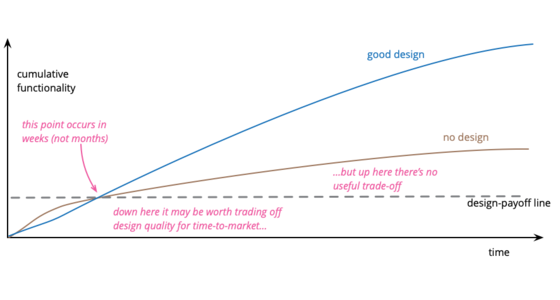
Is it worth the effort to design software well?
Domain Driven Design
Domain-Driven Design is an approach to software development that centers the development on programming a domain model that has a rich understanding of the processes and rules of a domain. The name comes from a 2003 book by Eric Evans that describes the approach through a catalog of patterns. Since then a community of practitioners have further developed the ideas, spawning various other books and training courses. The approach is particularly suited to complex domains, where a lot of often-messy logic needs to be organized.
Evolutionary S O A
Can SOA be done with an agile approach?
Monolith First
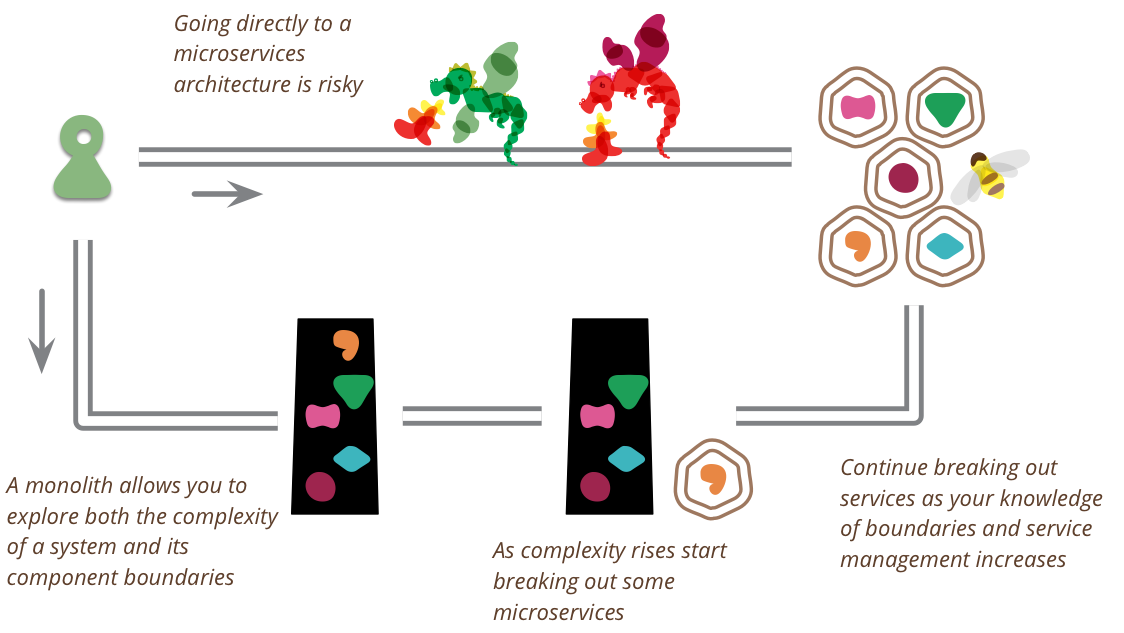
As I hear stories about teams using a microservices architecture, I've noticed a common pattern.
- Almost all the successful microservice stories have started with a monolith that got too big and was broken up
- Almost all the cases where I've heard of a system that was built as a microservice system from scratch, it has ended up in serious trouble.
This pattern has led many of my colleagues to argue that you shouldn't start a new project with microservices, even if you're sure your application will be big enough to make it worthwhile. .
No DBA
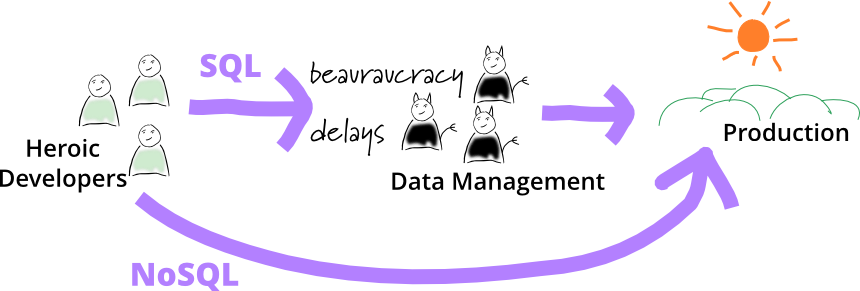
In many organizations, it's expected that any persistent data will be stored in relational databases that are managed by a central database management group. There are various reasons for such central control, usually centered around using IntegrationDatabases. Central data groups worry about keeping out malformed data, queries that can slow down important shared resources, and consistent data models across the enterprise.
Worthy these aims may be, but one consequence of them is considerable ceremony about storing data. I often hear complaints about change orders that take weeks to add a column to a database. For modern application developers, used to short-cycle evolutionary design, such ceremony is too slow, not to mention too annoying.
So application development groups tell me of using NoSQL databases to do an end-run around the DBAs. It helps that they are using a "mere datastore" here, not a "proper database". That way the DBAs can be kept out of the loop, often not told or happy to not care.
Parallel Change
Making a change to an interface that impacts all its consumers requires two thinking modes: implementing the change itself, and then updating all its usages. This can be hard when you try to do both at the same time, especially if the change is on a PublishedInterface with multiple or external clients.
Parallel change, also known as expand and contract, is a pattern to implement backward-incompatible changes to an interface in a safe manner, by breaking the change into three distinct phases: expand, migrate, and contract.
Sacrificial Architecture
You're sitting in a meeting, contemplating the code that your team has been working on for the last couple of years. You've come to the decision that the best thing you can do now is to throw away all that code, and rebuild on a totally new architecture. How does that make you feel about that doomed code, about the time you spent working on it, about the decisions you made all that time ago?
Seedwork
In the very earliest days of Object-Orientation, the OO advocates like me put a lot of attention into arguing in favor of reuse. Early on we talked about reusing of classes. Then we discovered that reusing individual classes, while it worked in some cases, didn't work so well elsewhere. So we got into reusable frameworks, which got us part-built applications of functionality.
Tolerant Reader
One of the benefits of using web services is that it helps you to decouple various parts of a system. People can work on separate code-bases with some degree of separation. Although you get some decoupling, you cannot eliminate the coupling completely because the services still have to communicate to each other through their interfaces. The sad thing is that many teams make this coupling much worse than it should be.
Yagni
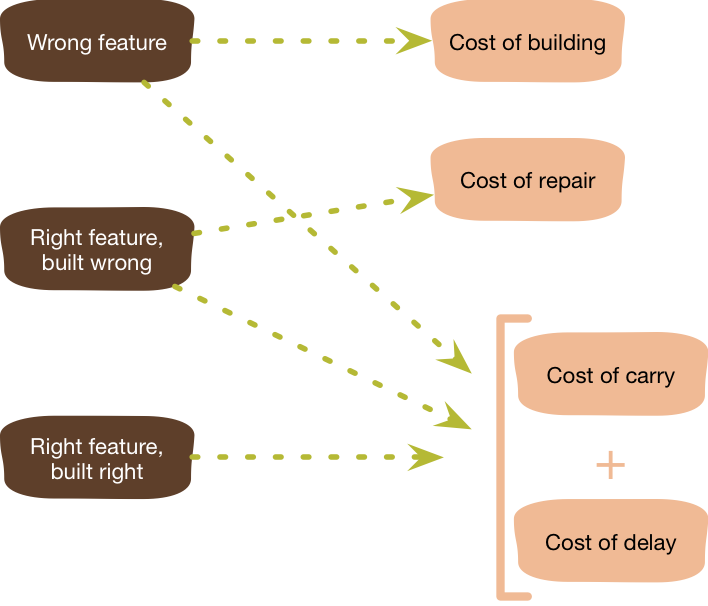
Yagni originally is an acronym that stands for "You Aren't Gonna Need It". It is a mantra from ExtremeProgramming that's often used generally in agile software teams. It's a statement that some capability we presume our software needs in the future should not be built now because "you aren't gonna need it".