
Test Driven Development
11 December 2023

Test-Driven Development (TDD) is a technique for building software that guides software development by writing tests. It was developed by Kent Beck in the late 1990's as part of Extreme Programming. In essence we follow three simple steps repeatedly:
- Write a test for the next bit of functionality you want to add.
- Write the functional code until the test passes.
- Refactor both new and old code to make it well structured.
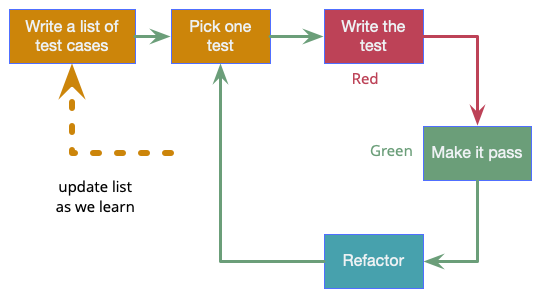
Although these three steps, often summarized as Red - Green - Refactor, are the heart of the process, there's also a vital initial step where we write out a list of test cases first. We then pick one of these tests, apply red-green-refactor to it, and once we're done pick the next. Sequencing the tests properly is a skill, we want to pick tests that drive us quickly to the salient points in the design. During the process we should add more tests to our lists as they occur to us.
Writing the test first, what XPE2 calls Test-First Programming, provides two main benefits. Most obviously it's a way to get SelfTestingCode, since we can only write some functional code in response to making a test pass. The second benefit is that thinking about the test first forces us to think about the interface to the code first. This focus on interface and how you use a class helps us separate interface from implementation, a key element of good design that many programmers struggle with.
The most common way that I hear to screw up TDD is neglecting the third step. Refactoring the code to keep it clean is a key part of the process, otherwise we just end up with a messy aggregation of code fragments. (At least these will have tests, so it's a less painful result than most failures of design.)
Further Reading
Kent's summary of the canonical way to do TDD is the key online summary.
For more depth, head to Kent Beck's book Test-Driven Development.
The relevant chapter of James Shore's The Art of Agile Development is another sound description that also connects it to the rest of effective agile development. James also wrote a series of screencasts called Let's Play TDD.
Revisions
My original post of this page was 2005-03-05. Inspired by Kent's canonical post, I updated it on 2023-12-11